Calculate how many customers you need to break even
You charge $25 per customer per month, spend $5 to serve each one and have $3,000 of monthly fixed costs. Each customer contributes $20. You need 150 customers to cover those fixed costs under this simple model.

When this helps
You are checking whether a small product can pay for itself. A revenue target alone hides the cost of each additional customer. Write the selling price, variable cost and fixed monthly spend separately, then calculate the number of customers needed.
How to calculate it
- Choose a consistent period, such as one month, for revenue and costs.
- Subtract variable cost per customer from the selling price to find contribution per customer.
- Divide fixed costs by that contribution and round up with ceil: a fraction of a customer cannot cover the remaining cost.
Inputs and formulas
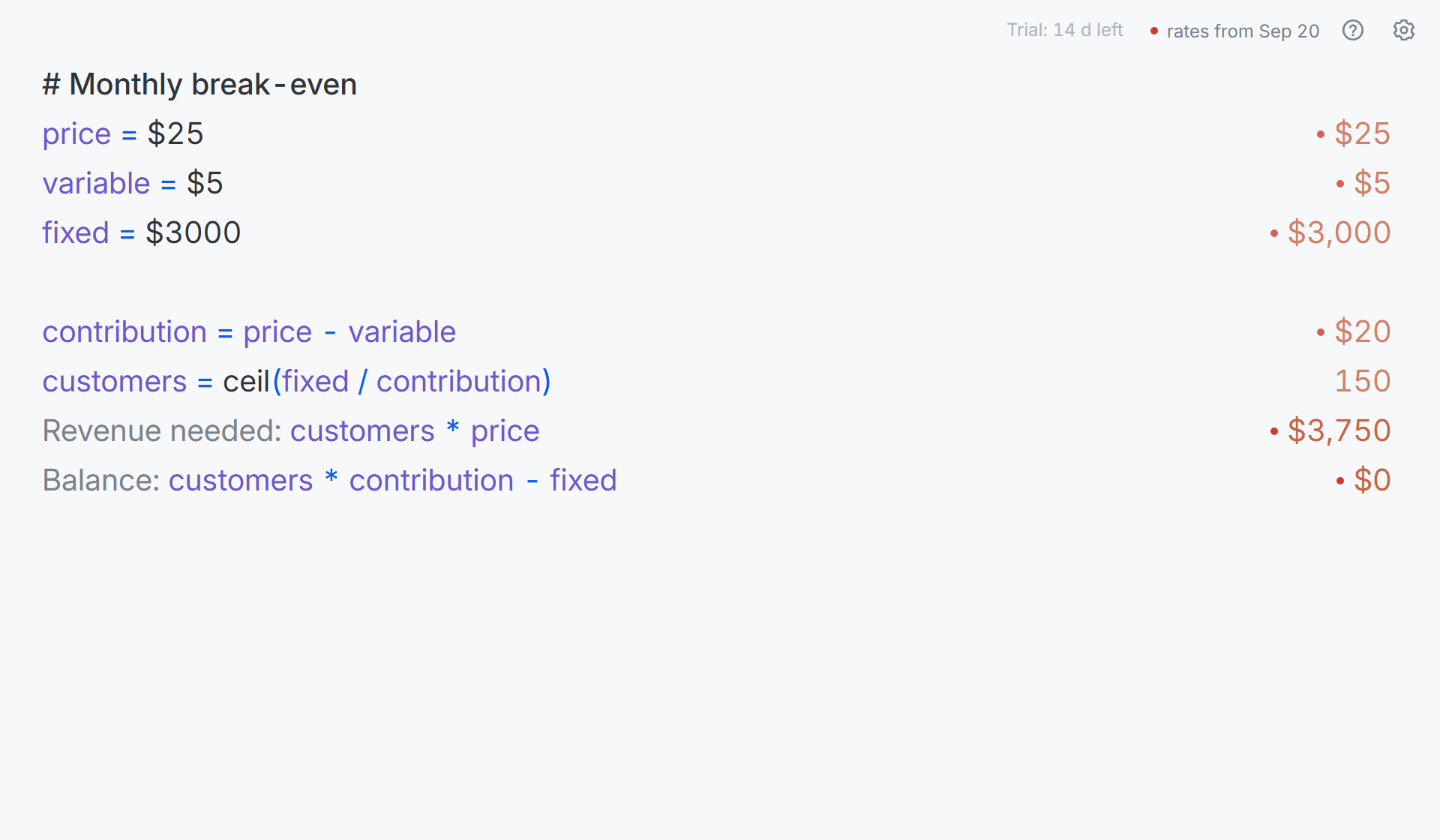
Copy these lines into Sumico or use the interactive example below. Decimal values in expressions use a dot.
# Monthly break-even
price = $25
variable = $5
fixed = $3000

contribution = price - variable
customers = ceil(fixed / contribution)
Revenue needed: customers * price
Balance: customers * contribution - fixed
Read the result
Contribution is $20 per customer. With 150 paying customers, revenue is $3,750 and contribution is $3,000. That exactly covers the fixed costs, leaving a balance of $0 in this model.
The calculation in Sumico
Change an assumption
Change price = $25 to price = $24. Contribution becomes $19, and 157.89 customers would be required before rounding. The practical target is 158 customers, producing a $2 balance above the entered costs.
Try the calculation here
Edit a number in the example. Results update on your device.
Assumptions and limits
Assume one product, equal revenue per customer and constant variable costs. Include payment fees in variable costs and owner compensation in fixed costs if relevant. Taxes, churn, discounts and capacity limits are excluded unless entered. If contribution is zero or negative, more customers cannot cover positive fixed costs under this model.
A common question
Why round the number of customers up?
Rounding down leaves part of the fixed costs uncovered. ceil returns the smallest whole customer count that reaches the calculated threshold.
Try Sumico free for 14 days
Keep this calculation in the app and return to it when your assumptions change.